Web3 Gaming in 2026: Hype, Value, or Both?
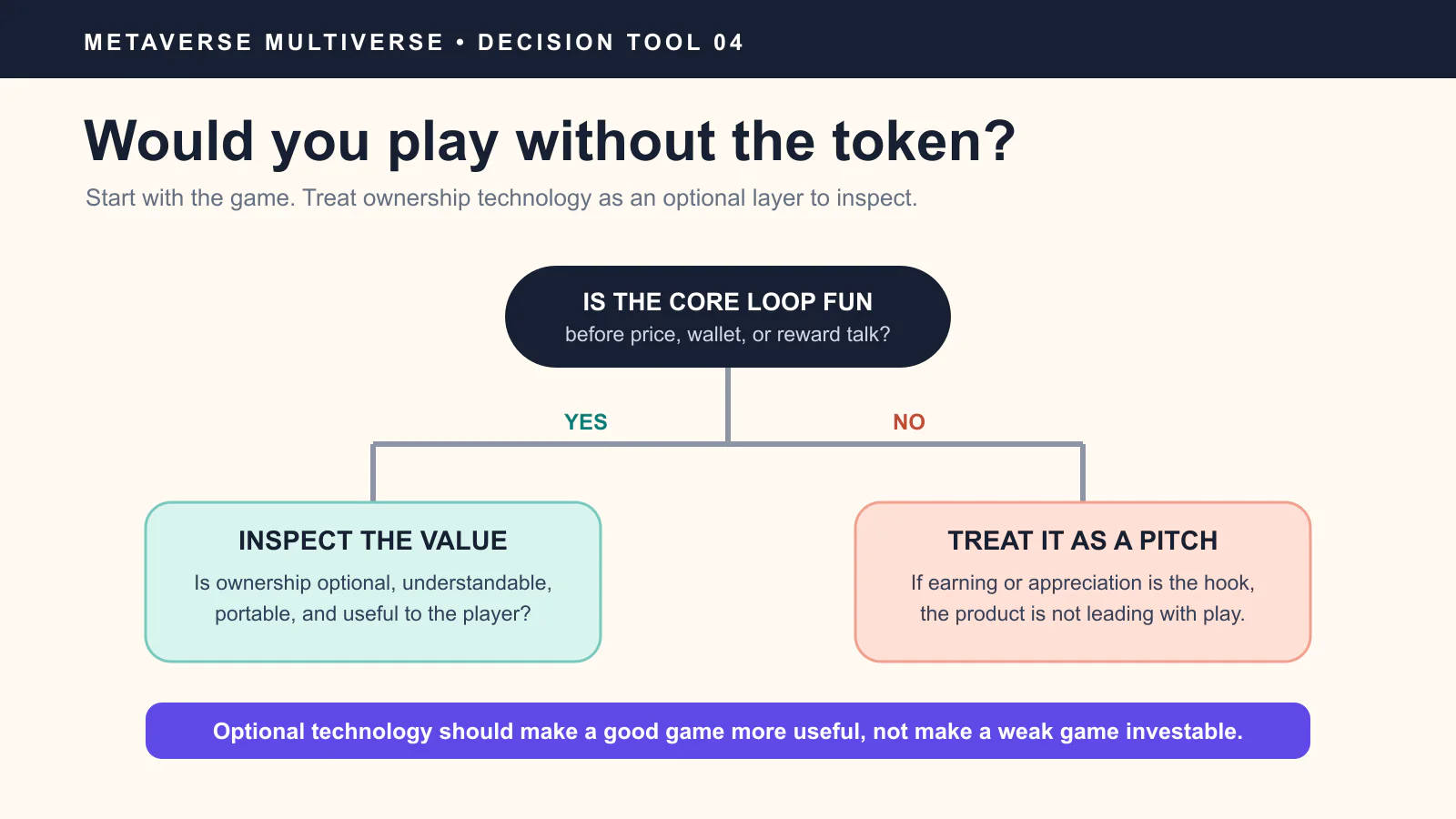
Image: Metaverse Multiverse
Few phrases empty a gaming forum faster than “Web3 gaming.” Years of cash-grab launches, play-to-earn schemes that collapsed the moment the earning stopped, and games that felt like spreadsheets wearing a costume left a deep, earned skepticism. Yet in 2026 the category has not vanished. It has quietly split in two. On one side, projects that put the game first and the blockchain somewhere in the back. On the other, the same old token machines hoping a new coat of paint fools someone. Sorting which is which is the whole skill now.
What is actually working
Strip away the noise and a few genuinely useful ideas have survived.
- True digital ownership, done quietly. When items you buy are portable or resellable and the game does not constantly remind you it is on a blockchain, players barely notice the plumbing and simply enjoy owning their stuff.
- Player-driven economies. Some projects are testing player-run markets where crafting, trading, and specialization serve the game. Stability and player benefit must be judged project by project.
- Interoperability experiments. Early, limited attempts to carry cosmetics or identity across services remain experiments. Technical compatibility, licensing, platform rules, and player demand all limit true portability.
The common thread: these succeed when blockchain is an implementation detail, not the pitch. The best 2026 examples are games you would play even if you did not know or care what powered them.
Where the hype still outruns reality
The failures rhyme with the old ones.
- Earning as the point. Any game whose main draw is making money attracts extractors, not players, and dies when the payouts thin.
- Speculation dressed as gameplay. If the “fun” is watching an asset’s price, it is a trading app, not a game.
- Friction for its own sake. Wallets, gas fees, and sign-everything prompts that add nothing but hassle still plague far too many launches.
A quick litmus test
| Sign it might have value | Sign it is mostly hype |
|---|---|
| Fun without owning any token | You only “play” to earn |
| Blockchain is barely mentioned | Blockchain is the whole pitch |
| Stable, player-run economy | Price charts front and center |
| Optional ownership features | Mandatory wallet to start |
| Studio talks about the game | Studio talks about the roadmap and coin |
Run any 2026 Web3 title through that grid and it sorts itself fast. If the answer to “would I enjoy this with the crypto layer switched off” is no, you have your verdict.
So, hype or value?
Both, and that is the honest answer. There is real value in ownership, portable items, and player economies, and those ideas are slowly maturing inside games that treat them as features. There is also still an enormous amount of hype, because the space keeps attracting people who want a financial product with a gaming skin. 2026’s progress is that the two are finally easier to tell apart. The tech is not the villain; leading with the token instead of the game is.
FAQ
Is Web3 gaming a scam? Not inherently, but the category has hosted plenty of scams. The technology can be legitimate; the business model built purely around earning is where most trouble lives.
Do I need cryptocurrency to try these games? Increasingly no. The better 2026 projects hide or remove the crypto friction so you can just play, with ownership as an optional layer.
Will Web3 merge with the metaverse? There is overlap in the idea of portable, owned items across virtual worlds. It remains more promise than product, but it is the most interesting thread to watch.
Key takeaway
Web3 gaming in 2026 is neither dead nor triumphant: the projects that lead with fun are quietly working, while the ones that lead with tokens keep proving the skeptics right. Judge any title by one question, and it will rarely mislead you: would you still play it with the blockchain turned off?
Published by BudLeiser, the studio behind Metaverse Multiverse.
web3blockchain-gamingmetaversecrypto-gaming2026